
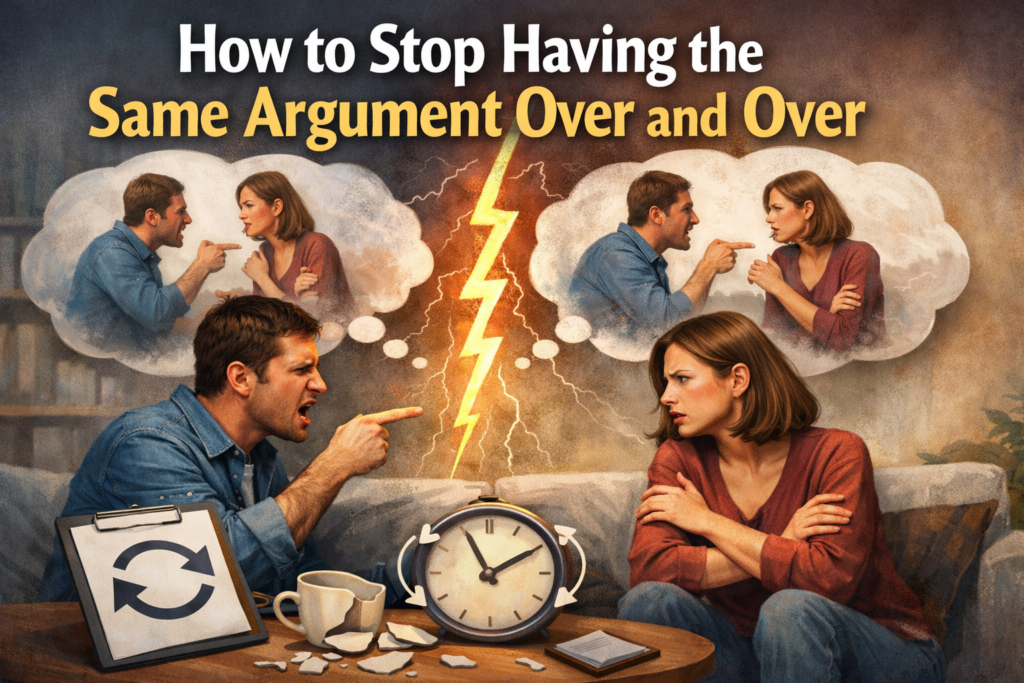
If you’ve ever thought, “We’ve had this exact fight before,” you’re not imagining it. Most couples don’t argue about dozens of different things—they argue about the same few themes on repeat. The topic changes (texting, money, plans, family), but the emotional experience stays the same: one person feels ignored, the other feels attacked, and both end up feeling alone.
The good news is that repeating arguments aren’t a sign that your relationship is doomed. They’re usually a sign that a predictable pattern has taken over—and patterns can be changed.
The real reason the argument keeps coming back
A repeating argument is rarely about the surface issue. It’s usually about what the issue represents. A late reply becomes “I don’t matter.” A critical tone becomes “I’m not safe.” A forgotten task becomes “I’m doing this alone.” When a moment hits a deeper nerve, your nervous system reacts fast—often faster than your logic.
That’s why “solving the problem” doesn’t always solve the conflict. You might agree on the plan, but if the underlying need (respect, reassurance, partnership, autonomy) isn’t addressed, the relationship doesn’t feel better. So the same fight returns the next time stress shows up.
The common cycle: pursue vs. withdraw
One of the most common patterns looks like this:
One person pushes for a conversation right now because they feel anxious and need reassurance. The other pulls away because they feel overwhelmed and need space. The more one pursues, the more the other withdraws. Then both interpret the other’s behavior in the worst possible way.
The pursuer thinks: “You don’t care.”
The withdrawer thinks: “Nothing I do is good enough.”
And suddenly the argument isn’t about dishes, plans, or tone. It’s about safety and connection.
Step one: name the pattern, not the villain
Here’s a shift that changes everything: stop treating your partner like the enemy and start treating the cycle like the enemy.
Instead of “You never listen,” try: “I think we’re in that loop again—where I push and you shut down.”
Instead of “You’re so dramatic,” try: “I’m noticing we’re both getting activated and it’s hard to hear each other.”
When you name the pattern, you lower the threat level. And when the threat level drops, real communication becomes possible.
Step two: find the deeper need underneath the complaint
Most complaints are clumsy translations of deeper needs. Anger often covers fear. Criticism often covers disappointment. Silence often covers overload.
A useful question is: “What am I needing right now that I’m not asking for clearly?”
Examples:
- “You never help” might mean “I need partnership and relief.”
- “Why are you so distant?” might mean “I need reassurance that we’re okay.”
- “You’re controlling” might mean “I need autonomy and trust.”
When you can express the need without blame, your partner has something real to respond to.
Step three: change the timing, not just the words
Many couples try to “communicate better” while they’re already flooded. But when emotions are high, the brain switches into protection mode. That’s when sarcasm, defensiveness, and harsh words appear—even if you don’t mean them.
If you’re both escalated, it’s smarter to pause than to push through.
A healthy pause sounds like: “I want to talk about this, and I don’t want us to hurt each other. Can we take 20 minutes and come back?”
The key is agreement: a pause is not abandonment. It’s a strategy.
Step four: use repair language during conflict
Repair is what separates healthy conflict from damaging conflict. Repair doesn’t require perfect words—it requires intention.
Try simple phrases like:
- “I’m getting defensive. Let me reset.”
- “That came out harsher than I meant.”
- “I hear you. Keep going.”
- “What I’m trying to say is…”
Even one repair attempt can stop an argument from becoming a spiral.
Step five: end the conversation with a clear next step
A repeating argument often repeats because the ending is fuzzy. You stop fighting, but nothing changes—so the same trigger returns.
Aim for one small, concrete agreement:
- “When we disagree, we’ll take a 15-minute pause before texting anything.”
- “We’ll do a weekly check-in on Sunday for plans and stress.”
- “If one of us needs reassurance, we’ll ask directly instead of hinting.”
Small agreements build safety. Safety builds trust. Trust reduces reactivity.
When repeating fights are a sign you need support
If you’re stuck in a cycle where every conversation becomes a blowup, or one of you shuts down completely, it doesn’t mean you’re broken. It means your relationship is trying to protect itself with strategies that no longer work.
Coaching can help you map the pattern, translate the deeper needs, and practice new ways of communicating—without turning every talk into a courtroom.
A final thought
Most couples don’t need more “tips.” They need a new experience: being heard without blame, being honest without fear, and repairing without shame. The same argument isn’t proof that you’re failing—it’s proof that something important hasn’t been understood yet.
And that’s a solvable problem.